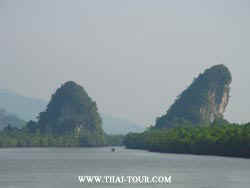
100 m high hills rising from the water, is regarded as the
symbol of Krabi. It sits before the city and can be
visited by long tail boat from Chao Fa Pier. Travel
time is about 15 minutes. From the boat, one climbs a
staircase to see caves with stalactites and stalagmites.
Many human skeletons have been found in the area. It
is theorized they are the remains of immigrants who became
stranded and died after a sudden flood.
is located about 3 kms from Krabi Town. Inside the cave there are
what appear to be tiger paw prints in the stone. The surrounding
area is covered with large trees hundreds of years old, particularly in
the Khiriwong Valley. Mountains are on all sides and there are
smaller caves in great number. Aside from being the site of a
meditation center, it is also a place of archaeological and historical
interest. Stone tools, pottery remains, and the mold for making
Buddha footprints have been found in excavations.
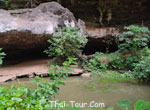
is located at Ban Nong Kok, Tambon Sai Thai, 7 kms from the town on
Highway No.4034. It is a beautiful cave with stalactites and
stalagmites. In 1909 the future King Rama VI visited the cave
here, earning it the title "Sadet" indicating the presence of royalty.
composed of eight small natural swamps in a vast valley of Tambon Khao
Thong. This forms part of a park which is being turned into
recreational area. Sa Kaeo is accessible by the Krabi-Nai Sa route
(Highway No.4034), a distance of 28 kms.
This marine national park covers the coastal area and other off-shore
islands within the district territory of Amphoe Muang. With white,
clean stretches of beach and scenic coral reefs, it also offers numerous
natural attractions such as the Hat Noppharat Thara beach, Hat Ao Nang
beach, the Susan Hoi or Fossil Shell beach, the Phi-Phi island group and
the Po Da island.
Hat Noppharat
Thara
About 18 kms from Krabi town along Nai Muang-Nai Sa Road, is a scenic
beach lined with casuarina trees which extend for several kilometres.
A rocky island, about 1 km from the mainland, can be reached by foot at
low tide. Minibuses leave the town to the beach daily from
6.00-17.00 hrs.
Accommodation at the beach is available. Reservations should be
made in advance at the Forestry Department, Tel. 5790529, 5794842.
is located at Ban Laem Pho, 17 kms from downtown Krabi along
the route to Hat Noppharat Thara. Long ago this was a
freshwater marsh populated by clams and other bi-valves,
chiefly little two centimeters long "Hoi Khom" or pond
snails, which grouped and multiplied in such numbers that
the dead formed a floor for the living. This process,
repeated over eons, led to the creation of layer of fossils
about 40 cms thick, called shelly limestone.
Scientific test have established that the age of these
fossils is about 40 million years. Minibuses leave the
town for the Fossil Shell Beach daily from 6.00-17.00 hrs.
is situated 6 kms south of Hat Noppharat Thara next to a road that runs
parallel to the coastline. A scenic bay, its white sandy beach
stretches to the foot of a conspicuously prominent limestone range.
Accommodation is available along the the beachfront. Other
facilties include diving shops, boats for rent a sight-seeing by canoe.
From Ao Nang bay, tourists may hire boats to visit nearby attractions
such as Hat Rai Le, Tham Phra Nang, Sa Phranang located on land to the
east of Ao Nang, as well as other off-shore isles of Poda, Tap and Mo.
are located at an equal distance from both Krabi and Phuket, about 40
kms. Made up of six small and large isles, the main features are
sheer limestone cliff and rock. Some offer beautiful beach and
coral reefs. The best time for a visit is between November and
April.
is home to fishermen and Thai Moslems.
Located about 2 kms from Ko Phi Phi Le. This island has a total
area of 28 sq.m. An outstanding attraction here is Ao Ton Sai, a
vast bay with a curving white sandy beach stretching to a mountain range
which reaches into the sea. The clear waters are prefect for
swimming. There is also a pier on the beach where visitors can
easily get on a get off a boat On the other side, a fishing village is
located at Laem Tong, an area renowned for its underwater natural
beauty. Coral reefs can be found on both sides of the island.
Tourists who wish to dive or hire a boat are suggested to contact tour
operators on the island. Most are situated in Ao Ton Sai area.
lies to the north Phi Phi Don,
and not very far from Ko Yung. There are loverly
beaches on the north and east sides, and coral gardens
spreading to the south.
an island of steep cliffs, covers a total area of 6.6 sq.m. A
small bay called "Pi Le" reaches into a valley and gives a lake-like
scenery. This part of the sea is almost encircled by steep cliffs.
The waters are still, clear, and deep. To the south of Pi Le, is a
small bay which hides in a fold of a steep rock. This is called
"Lo Sa Ma". Another attraction is Tham Viking, a huge, vast, and
airy cave which is home to a large number of swallows. On the cave
walls are ancient paintaings of sailing sips similar to those used by
ancient Vikings. Near the entrance, there is a spectacular
collection of stalagmites and stalactites.
In 1972 Tham Viking was renamed Tham Phaya Nak or The Great Serpent Cave
by H.M. the king because of a serpent like rock inside.
Ko Phi Phi can be reached by boat either from Krabi or Phuket. In
downtown Krabi tourists can take a boat at Chaofa pier. The boat
leaves for Ko Phi Phi daily. Boat tickets are available at the
pier or from travel agents in the town. It takes about 2 and a
half hours for the journey. The fare is about 150 baht per person.
Regular boats from Ao Nang to Ko Phi Phi are also available.
Please contact TAT Krabi Office (Tel: (075)612740) for current
information.