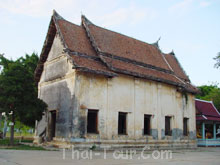
These two European style
buildings are located on Wilaichit Road by the Chao Phraya
River
in the town. Both are constructed at the same period, some
90 years ago during the reign of King Rama V. They are still
in perfect condition.
Wat Na Phrathat
This temple, first called
“Wat Hua Mueang” by the villagers, is located 1 km.
west of Wat Phra Non Chaksi. It houses an ancient brick
pagoda which was built during the ancient
Khmer’s glory. The pagoda was later renovated during the
early Ayutthaya period.
This area is assumed to have been the ancient site of Sing
Buri.
Wat Phra Non Chaksi
This temple is 4 kms.
south of the town along the Sing Buri-Suphan Buri
route. It houses a huge Sukhothai-style reclining
Buddha image, which is revered by the local people
and renowned for its large size, almost 46 metres
long.
Wat Sawang Arom
This temple is situated
in the town. It is a centre for Buddha image
sculpture. The technique was handed down from the
Ban Chang Lo School in Thon Buri. A collection of
300 Nang Yai or shadow play figures at this temple
is considered the most complete in Thailand.
This temple is situated in the town. It is a centre
for Buddha image sculpture. The technique was handed
down from the Ban Chang Lo School in Thon Buri. A
collection of 300 Nang Yai or shadow play figures at
this temple is considered the most complete in
Thailand.
This temple is situated
in the town. It is a centre for Buddha image
sculpture. The technique was handed down from the
Ban Chang Lo School in Thon Buri. A collection of
300 Nang Yai or shadow play figures at this temple
is considered the most complete in Thailand.
White chapel in the district. Away from
the Temple Church Si Worawihan to sleep about 9 km
villagers commonly called Luang Pho Phae (Phra Thep Sing
Chan Bush mold. Sing Buri primate) that this temple the
statue blessing Lord Buddha is the largest in Thailand
Suvarnabhumi Mongkol Maha Muni. Size 2 cubits wide 11 Wa
Wa 7 inches high 21 inches within the first three
concrete progress. Mosaics decorated with 24 K gold
natural species around the temple are the major Wiharcd.
Which enshrines Buddha image daily various There is also
a garden and building a beautiful Dharma interesting
Surrounded by the peaceful atmosphere.
In Buri
In Buri National
Museum
This museum is situated
inside a temple called Wat Bot. It exhibits several old
objects such as King Rama V’s palanquin, large shadow
play figures, various styles of “Phat Yot”(monk
ranking ecclesiastical fans), a Green Stone Buddha
Image, and an ancient sugar cane crushing machine.
Wat Bot
This is an old temple
constructed in an unusual style having iron rails as the
core of the lower part. The window and door panels of
the chapel were carved exquisitely by the best artisan
of Sing Buri, a man by the name of Chuen Hathakosol, who
devoted 10 years of his life doing this piece of work.
Wat Muang
is located in the river
bank in Buri Chao Phraya River to the road 1117 away
from the market in Buri, turn left to around 2. 5 km
assume that built up in the King Chulalongkorn at the
beginning of the year, in 2 2 Previously, it was the
beginning of the mango, so called “ Muang Temple ”
within temple is an old temple building cement
foursquare on the ground, with a porch out by craftsmen
decorated with the vessel, the cup in the temple with
the Buddha image bhumisparsa Buddha beautiful enshrined
on the base Chuk, a base like a lion Bua large base
supports the ceiling decorated with paintings are
star-shaped mural paintings depicting, dust cunning work
these days, assume that the king Rama wrote in the 4 and
is the story story of the Buddha images as well as life,
such as ancient culture of the society in a good.
Muang Boran
(within vegetation garden city ditch) is
located in the house Khu Mueang District steep
vegetation in the garden city ditch away from the
province about 23 kilometers presumed to be a community
ancient Phan town square executive council wide 650
meters long 750 meters from the floor 1 meters with a
large topple sideways into a land units surrounded the
variegated earthenware found many pots and pans
crockery, a string of beads rocks, water and other
units, a terra-cotta dhammachakka green stone, earrings,
beads stone, and has a dedication on silver, “ Si the
Dvaravati Siripen Sitasuwan ” bridging a great King
shows that a community live in this area, since the
time, Fujitsu, Hanan until the
current Rattanakosin antique discovered that led to kept
from the National Museum in Buri and within the area
ancient city home city ditch at present the vegetation
is the garden with the area about 500 rai is surrounded
by ancient topple sideways into a plants, very beautiful
scenery on the road use national road number 3 line Sing
Buri - In Buri (old) kilometers away from the 17 or
district in Buri about 7 kilometers, turn left into the
line number 3285 lines in Buri-Nong at random.
Wat sutthawas
located in Tambon Tub, amphoe in buri in
accordance with the Highway no. 311 (Sing Buri-in Buri)
kilometers from the 11-12, from Wat ylang-ylang flowers,
and about 5 kilometers.
Bang Rachan
Wat Phra Prang and Ancient Kilns
This ancient site is
located in Tambon Choeng Klat, Amphoe Bang Rachan, 17
km. west of the the town. The temple contains an old
pagoda of the Lop Buri style assumed to have been
constructed during the reign of King Narai the Great.
The pagoda measures 15 metres high and has some Buddha
images at its base. Not far from the pagoda, 3-4 ruined
ancient kilns have been discovered. They were used for
firing earthenware during the Ayutthaya period. The
kilns were relatively large and once produced jars,
bowls, mortars, pots, gable tops, and floor tiles.
Located in the area Wat
Phra Prang is the source of pottery kiln in those days,
Krung Si Ayutthaya, stove tops, which is a kind of cool
northwest up the brick stove, some like a boat
exclusively capital called "a furnace, a cover "the
furnace, is a large is the length of up to 14 meters
wide diameter of 5.60 meters and a chimney smoke long
2.15 meters used as a production earthenware bowls such
as a jar mortar Kapook chofa tiles, etc. , for example,
the pottery dug around the source of the river
Incinerators at least you can see it in a cell of the
abbot source of archeology of this is not only a culture
heritage more important source of one, it is also an
academic study center of the great garment of one of the
world.
Park Mae La Maha
Rachanusorn, Singburi
Far from Muang, in accordance with the
highway 309 about 9 km , turn to ban the pelvis shortcut
to approximately 1.5 km to the park, that "Mae La, is
the name of rivers in the fertile Sing Buri District 3
flows through the area is amphoe in buri district Bang
Rachan and Muang Sing Buri River abundant food of the
fish, so fish caught from Lam Mae La, and a taste it,
particularly fat soft skinks Mae La, which is the food
and deposit is well-known Sing Buri Province, Skinks Mae
La rare every day.
by the government to conserve and restore the dredge
river water hyacinth get rid of culture and to extend
new breed fish and building Mae La maharajah of the
ChakriDynasty up the river, by all around the building
of the place for recreation of the people who visit to
visit
this project is in addition to offering the shrine unto
the LORD Buddha Majesty King Rama 9 in commemoration of
the prospered; his birthday anniversary 60 th birthday
anniversary.
Khai Bang Rachan
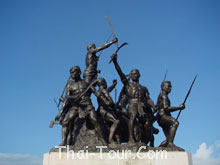
Monument of
Bang Rachan Heroes
This is situated in
Amphoe Khai Bang Rachan, 13 kms. southwest of
the town on Route No. 3032. The statues refer to
the villagers of Bang Rachan who bravely fought
against the Burmese army in 1765 during the
reign of King Ekkathat of Ayutthaya. In spite of
many more troops than the villagers, the Burmese
had to make eight attacks before the villagers
were defeated due to their shortage of weapons.
Wat Phikun Thong
This temple in Tambon
Wihan Khao, Amphoe Tha Chang, is 9 kms. from Wat Phra
Non Chaksi. Visitors come here to pay homage to the
statue of Luang Pho Phae, a famous former abbot of the
temple. The temple also houses Thailand’s largest
sitting Buddha image, 23 metres wide and 42 metres high,
made of concrete and decorated with golden mosaic.
Wat Pho Kao Ton
This temple is near the
Monument of Bang Rachan Heroes. It was the base where
the Bang Rachan villagers resisted the Burmese attacks.
A replica of the ancient fortress, identical to the
original, was constructed. In a chapel, there is the
statue of Phra Achan Thammachot, who was both a monk and
a leader of the Bang Rachan's heroes.
Promburi
Wat
Kudtithong
located in Moo 3, 1981 km from some
rapids 17 from the city on the route away from
the 32 District about 400 meters in the temple
looks like a mondop chedi containing the relics,
and within the top of a mondop, it is to
establish Bahts metal model is regarded with
veneration, in addition, the temple church
Thong, arts and culture Center these days, a
Thai forest, which has implements to accrue in
their daily life of Thai rice farming, forest
tool to trap animals caught fish, as well as
culpability vehicles, including the land, water
is the oldest in the audience, please contact
the Khru visit kind นุศาสน์ Abbot of Wat church
Thong and Capt. to begin Indra generations, and
to keep these days, arts and culture Center
temple
church Thong District, some rapids Amphoe Phrom
Buri province Sing Buri or contact you Suvarn
Valaisathien Pho in 2283 net profit at official
call (036) 512230 Saturday-Sunday call (036)
511902
Wat Phraprangmuni
It is far from the city, in accordance
with the highway 32 to Amphoe Phromburi at Km.8 is a
temple in the picture a mural within church wrote in the
year, the 2462 as a picture writing skilled villagers
but still the beautiful to match, with the other amphoe
khai bang rachan
Co Camp Myanmar
in the house chedi Moo 1
tumbonbaanpang to town to the south about 13 kilometers
on the road number 32 is the source of ancient community
is a long line hill looks like the L wide about 5-15
meters long about 3 meters สันิษ base, built in those
days, Krung Si Ayutthaya about a year ago copyright
2127, the Burmese army, and set the mouth of some
jujubes. To gather strength to beat Krung Si Ayutthaya.