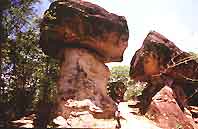
Nong Bua Lam
Poo is 568 kilometres from Bangkok. It used to be the site
of an ancient city over 900 years ago and was once a part of
Udon Thani Province. It was established as a province
outright on December 1, 1993. It has an area of 3,859 square
kilometres and consists of the following districts:
Mueang, Non Sang, Si Bun Rueang, Na Klang,
Suwannakhuha and Na Wang.
King
Naresuan the Great shrine
This shrine is in the public park opposite the
provincial hall. It commemorates the time when
King Naresuan the Great of the Ayutthaya period
led his troops to Nong Bua Lam Phu in 1574 on
the way to helping the king of Hongsawadi fight
the city of Si Sattana Khanahut.
Million-year-old shell fossils
This archaeological site is approximately 10
kilometres from town on the Nong Bua Lam
Phu-Udon Thani road. Mollusk fossils have been
found here buried in sandstone. The fossils are
about 140 million years old.
Namtok Thao To Forest Park
This is 3 kilometres from town on the way to Udon
Thani. A road here runs through a mountain.
There is a small waterfall covered with large,
shady trees. Nearby is the Chao Pu Lup Shrine
which is worshipped by the locals. Cars passing
the shrine usually honk their horn as a sign of
respect and for good luck on their journey.
Phra Wo Phra Ta City shrine
This shrine is beside Road No. 210 (Nong Bua Lam
Phu-Udon Thani). It was built to honor Nong Bua
Lam Phu’s founder.
Pottery-making at Ban Khong Sawan
This pottery village is 17 kilometres from town on
the way to Udon Thani. The villagers here
migrated from Ban Wang Thua, Amphoe Nam Phong,
Khon Kaen. The village specialty is making
pottery with designs similar to that in Ban
Chiang and using traditional techniques.
Wat Tham Klong Phen
This temple is at the foot of Phu Phan mountain,
13 kilometres from town on Highway No. 210 (Nong
Bua Lam Phu-Udon Thani), then 2 kilometres on
the right. The area was once the site of an
ancient Khmer temple that later became deserted
until 1958 when Phra Achan Luang Pu Khao Analyo
turned it into a meditation centre until his
death in 1983. A museum displays his wax figure
as well as his personal items. The temple is
very peaceful with a large area and covered with
shady trees and natural rock formations. It is
most suitable for meditation.
Non
Sang
Phu
Kao-Phu Phan Kham National Park
This park covers 322
square kilometres. The park headquarters
is near the lake at Ubonrat Dam at the
foot of Phu Phan mountain in Non Sang.
From Nong Bua Lam Phu, take Highway No.
2146 (Nong Bua Lam Phu-Non Sang) for
about 40 kilometres to the intersection
at Ban Sok Chan, then a left onto the
Ban Sok Chan-Ubonrat Dam road for about
14 kilometres to the park office. From
Khon Kaen, there is a 7-kilometre road
from the dam to the park office.
Phu Phan Kham is a part of Phu
Phan mountain range. Stretching north to
south, it divides Nong Bua Lam Phu and Khon
Kaen. The view of the lake at Ubonrat Dam is
magnificent. Tourists frequently overnight
near the park office beside the lake.
Phu Kao consists of 9
mountains. The most interesting spots branch
out eastward from the Non Sang-Nong Bua Lam
Phu road. On the laterite road to Ban Kut
Bak are observation points, prehistoric
drawings at Mum cave, Wat Phra Phutthabat
Phu Kao, rock recesses shaped like human and
dog footprints that are the source of local
folklore, dinosaur footprints on a rock
plateau near a stream, and Tat Fa waterfall.
A park official is required as guide into
Phu Kao.
Na
Wang
Tham Erawan
This cave is 45 kilometres from
town on Highway No. 210 (Nong Bua Lam
Phu-Loei) past Na Klang and Na Wang to Km.
13, then a right for 2 kilometres and up
about 600 steps by foot up the mountain. At
the mouth of the cave is a large Buddha
image clearly visible from a distance.
Inside the cave is a large space with lovely
stalactites and stalagmites. The cave is the
origin of local folklore called Nang Phom
Hom.
Suwannakkhuha
Phu Pha Ya Archaeological Site
This is north of Ban Na Charoen
in Tambon Dong Mafai. In Wat Phu Pha Ya
Thammasathit are prehistoric drawings on a
mountain. The drawings are of red paint and
depict geometric figures, animals, palm
prints, and humans. They date from
2,000-3,000 years ago.
Wat Tham Suwannakhuha
This temple is around 5
kilometres from the district office. A
Buddha image built by Phra
Chaiyachetthathirat of Vientiane in 1555 is
here. It was built at the same time as Phra
Chao Ong Tu and Luang Pho Phra Sai in Nong
Khai.